 Pachena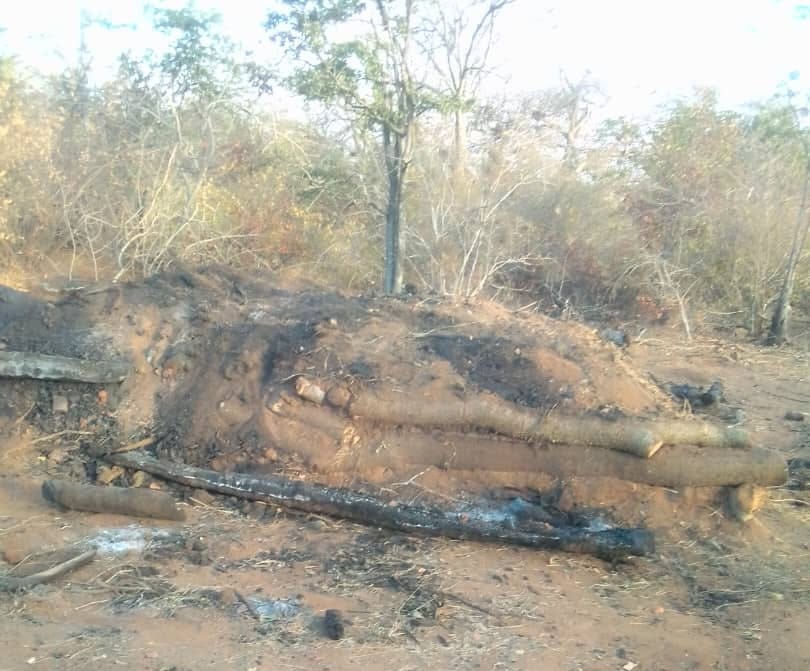
ONCE hailed as Zimbabwe’s great diamond frontier, the forests of Chiadzwa are being quietly consumed — felled by axe or chainsaw, reduced to charcoal, and carried away through one of the country’s most heavily guarded security zones. A Pachena investigation has found that mass retrenchments, broken community benefit promises and institutional failure are driving an accelerating ecological disaster in the Eastern Highlands.
By Nathan Guma
Deep in Zimbabwe’s diamond-rich Chiadzwa, the forests that once blanketed the Eastern Highlands are disappearing — not to make way for more mines to unearth the lucrative glittering gems, but for something far darker and more desperate: charcoal.
A recent Pachena investigation has found that rising unemployment following mass retrenchments by mining companies is fuelling runaway deforestation across one of the country’s most ecologically sensitive regions. This as displaced workers and impoverished villagers turn to charcoal production to survive.
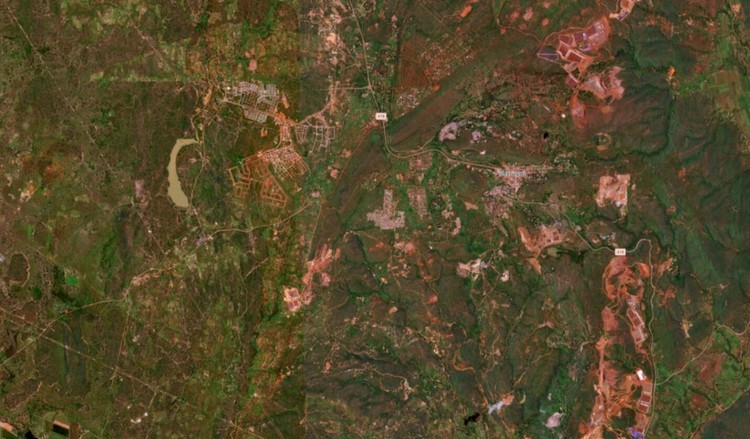
The destruction is visible from space: satellite data comparing imagery from 1980 to 2023 shows that villages along the Save River, once lush and green, are now starkly barren. The river itself has narrowed, choked by silt from the cleared hillsides.
“(With all the clearing of forest) You might even think that there is some agricultural practice (crop planting) about to take place,” Dorcas Chiadzwa, a Chiadzwa Village resident tells Pachena. “They do not leave anything, even twigs. They use the twigs for making fire. This has been going on for years now and no action has been taken.”
The story of Chiadzwa is, at its core, a story of a promise broken. When major diamond companies — including ZCDC, the state-owned entity that consolidated operations in the area — moved into the fields, communities were told the industry would anchor their livelihoods.
Under the Zimbabwe Diamond Policy, companies operating in the extractive sector are required to allocate five percent of their profits to host communities for development. That money, residents and civil society say, has never arrived in any meaningful way.
Cosmas Sunguro, executive director of the Zimbabwe Diamond Allied Workers Union (Zidawu), puts the human cost in blunt arithmetic. “Recently, more than 300 locals were retrenched by ZCDC,” he said. “Normally, if one family person takes care of more than six people, and 300 people suddenly become redundant — that’s more than 1,800 people suddenly without income. And besides that, there’s a high unemployment rate in Zimbabwe.”
Sunguro is careful not to accuse retrenched miners directly. “I’m not saying they are the perpetrators. But I’m saying the kind of pressure that you find on this side — that’s what’s driving it. At the end of the day, there’s no choice but to resort to some of these activities. The main cause of this deforestation is poverty.”
According to villagers, the charcoal trade follows a simple routine: trees are felled, chopped into logs, burned and then cooled with water or soil.
The finished product is sold to urban blacksmiths who use it to smelt aluminium from discarded beverage cans. What was once a modest subsistence activity has, by multiple accounts, metastasised into an industrial-scale operation. And the damage is now encroaching on territory that generations of local communities have considered sacred.
Sacred Ground Lost
“Trees are being cut down in Chibiya and Tonhorai Villages,” says Dorcas Chiadzwa. “This has been encroaching into places like Chipundo, close to the Save and Odzi rivers — places that have been known to be sacred and had springs of water that never ran dry.”
Wagonekwa Mukwada of Mukwada Village confirms the severity. “This (cutting down trees) used to be done in a controlled way, but now, our land is being defaced,” he said, noting that siltation has already affected local dams and triggered disease outbreaks among livestock.
What makes the degradation particularly alarming is its longevity.
Some of the indigenous trees being harvested, such as the Mopane, can regenerate after cutting. But mature hardwoods prized for charcoal can take between 20 and 40 years to regrow — meaning the ecological damage unfolding today will outlast the careers of any official currently responsible for managing it.
Institutions Failing to Respond
That management, such as it is, appears to be failing. Residents say they have repeatedly engaged the Environmental Management Agency (EMA), to little effect. EMA’s environmental education and publicity manager, Amkela Sidange, referred questions to the Forestry Commission of Zimbabwe, which responded only that it would assess the affected areas. No timeline was given.
“EMA intercepts most cars,” Dorcas Chiadzwa said. “But we have not seen any change, and we think it is important for them to go to the areas and villages where the deforestation is taking place.”
The Smuggling Question
Perhaps the most troubling dimension of this story is how the charcoal is getting out at all. Chiadzwa falls under the Protected Places and Areas Act (PPAA), a designation that restricts movement in and out of the diamond fields and places the area under heavy security.
Yet bulk quantities of charcoal are somehow making it through, travelling up to 150 kilometres to urban centres without apparent detection.
Sunguro suspects something more organised than individual enterprise. “It’s not easy to travel all the way from Chiadzwa to town without being detected by the police,” he said. “But you’d wonder how the charcoal is being smuggled. How are people burning it when there is plenty of security in the place? We are talking of a highly securitised area, but these things are happening under their nose. Somehow, the big fish were benefiting.”
Zidawu says it has been running awareness campaigns in schools and communities, working alongside EMA and Parks and Wildlife authorities. But against the scale of economic desperation, environmental education has its limits.
Chiadzwa’s diamond fields were once a symbol of Zimbabwe’s resource potential — a place where the earth’s geological wealth might finally translate into prosperity for ordinary Zimbabweans.
Instead, what is being extracted now is the landscape itself, tree by tree, while the promises that were supposed to prevent exactly this remain, like the diamond royalties, conspicuously undelivered.