 Pachena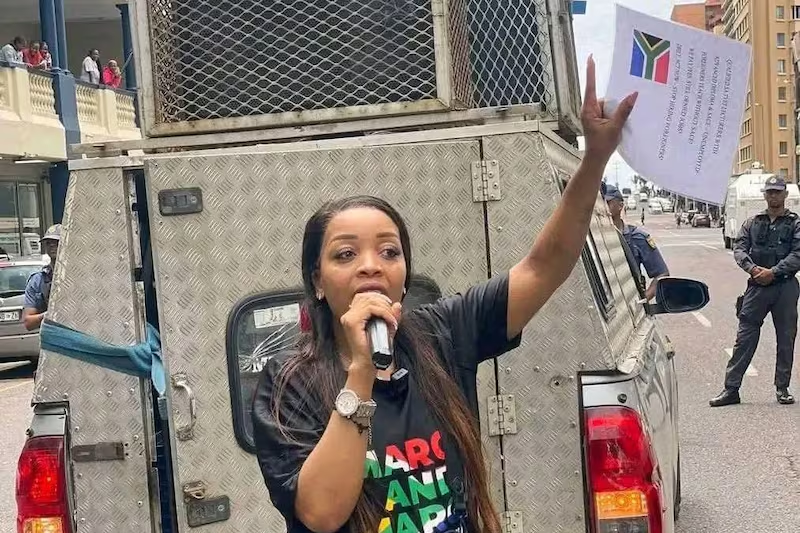
…March and March leader spits fire, turns the continent’s shared liberation history on its head
FEW movements in post-apartheid South Africa have polarised public opinion as sharply, or as swiftly, as March and March. In barely two years it has grown from a fringe rallying cry into a nationwide campaign capable of filling streets across multiple provinces, blockading hospital entrances, and forcing long-buried government reports into the open. To its supporters, it is the overdue voice of citizens demanding that their own laws be enforced. To its critics, it is a vehicle for xenophobia, dressed in the language of legality and broadcast with the polish of a seasoned media professional.
At the centre of it all stands Jacinta Ngobese-Zuma, a radio presenter, supply-chain graduate, and the movement’s unflinching figurehead. As March and March escalates its countrywide push to drive undocumented migrants out of South Africa, she has become one of the most talked about individuals in the regional immigration debate. The allegations trailing her movement are serious: incitement, intimidation, the obstruction of medical care, violence and a death toll that critics lay at the door of her rhetoric. There are questions about March and March’s funding, its methods, and its true political ambitions.
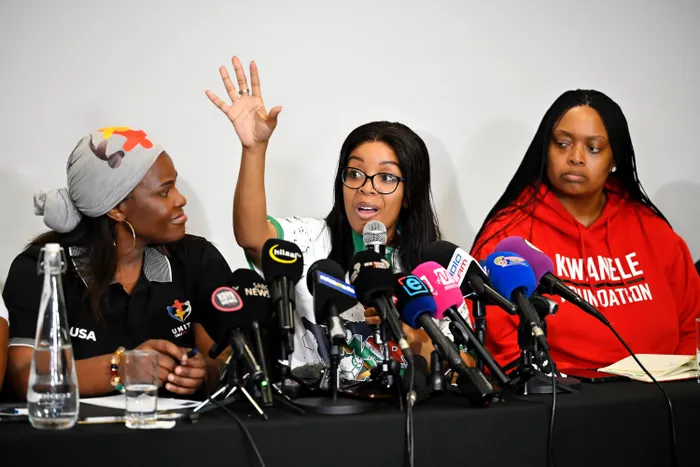
Pachena News Media’s Senior Journalist Brenna Matendere engaged Ngobese-Zuma for a wide-ranging and, at times, combative exchange. Across the conversation she rejects the xenophobia label outright, dismisses reports of violence at her marches, casts herself and her movement as the real victims of disinformation, and turns the continent’s shared liberation history on its head. Whether her answers amount to a coherent civic philosophy or a careful deflection is a judgement Pachena leaves to readers.
Pachena: March and March has emerged as a highly visible group in South Africa’s ongoing debate surrounding immigration and border control. What exactly is the March and March movement, and what specific outcomes is your organisation actively working to achieve in South Africa?
Ngobese-Zuma: March and March is a movement that is fighting illegal immigration in South Africa. There has been a huge influx of illegal immigrants into South Africa. The government does not even know the number of those people and the numbers keep growing. This is compromising the safety and security of South Africa. So, we took it upon ourselves to fight this. We are aware that anyone who takes it upon themselves to fight illegal immigrants is labelled xenophobic.
Pachena: In 2023, you were selected to participate in an International Visitor Leadership Programme in the United States, specifically focused on media responsibility in an age of disinformation. How would you describe your commitment to media responsibility given that on national radio, you have peddled unverified claims that, among other things, 60 percent of serious crime in Gauteng is committed by foreign nationals?
Ngobese-Zuma: The disinformation has in fact been targeted at us. We are the victims of disinformation, and it has been absolutely terrible. It is even more shocking when you see that even trusted outlets, like one international media outlet (name withheld) that you would expect to report accurately and in a responsible, only to find this particular outlet is far from it. A case in point was one time when we marched to the Union Building (seat of government in Pretoria) to hand over a memorandum to government. However, the reporter from that international outlet told a completely different story.
Pachena: You have spoken about NGO-funded military bases which have been disputed as non-existent. What is your reaction to a view that you are weaponising the exact disinformation tactics you were trained to dismantle in order to build your political profile?
Ngobese-Zuma: I am confused I don’t understand what you are talking about. I have never spoken about NGO funded military bases. What I have spoken about is the issue of NGOs who are using their money for charity work for refugees to buy arms and this was confirmed by the department of social development in South Africa. I don’t remember talking about military bases. I don’t know where the question is coming from. Maybe it was someone else who said it. It cannot be disinformation when I did not say it.
Pachena: You hold a degree in Supply Chain Management from the University of KwaZulu-Natal. Economic research consistently shows that immigrant-owned spaza shops in the townships offer lower prices to poor South Africans precisely because they utilise highly efficient, centralised supply chains and bulk-buying networks. As someone who understands supply chain mechanics, why do you intentionally mischaracterise basic economic efficiency and market competition as a “mafia hijacking” of the township economy?
Ngobese-Zuma: This is absolutely inaccurate. South Africa loses at least four trillion rands annually because of illicit goods coming through our ports which are largely non-functional. They (ports) only have one machine to detect which goods are coming into the country. So, the reason why they (immigrant spaza owners) are selling cheap products is that they are selling fake products. Their products do not go through proper channels so that they are taxed or go through SAB standards of approval to check if the goods pass the standards test. To back up what I am saying, there are children who are dying in South Africa after consuming cheap goods they buy from these shops. So, this supply chain model you are bringing up is completely inaccurate.
Pachena: International drug syndicates from Eastern Europe, Asia, and the Americas frequently operate in South Africa by allegedly bribing corrupt Home Affairs and border officials. Yet your movement seems to be focusing on the intimidation of delivery drivers, informal street traders, and even primary school children. Why does your campaign disproportionately target the poorest and most vulnerable African migrants, while largely ignoring the corrupt state officials and wealthy transnational criminals who actually compromise your borders?
Ngobese-Zuma: I don’t think you are keeping up with what we do. That’s why you think we’re targeting certain people. We sit in meetings with the Home Affairs Department almost every week.
There is the issue of the Special Investigating Unit (SIU) report which exposed deep-seated, organised syndicates within the Department of Home Affairs (DHA) that treated South Africa’s immigration and visa system as a for-profit marketplace. They (authorities) had been sitting on the SIU report since 2024, and it was only recently released because of March and March. There is also the issue of White Paper (on Citizenship, Immigration and Refugee Protection), which they (authorities) had been sitting on for several years and not giving it to the public to make comments. It too (White Paper) was only released to the public recently because of March and March.
We have sat in parliament, and we have given them (legislators) suggestions, ways of solving the immigration crisis. We even go to employers who are employing them (undocumented migrants); we go to meetings with the business sector to remind them of their responsibility not to employ undocumented migrants. We’ve gone to drug dens where foreigners, mostly Nigerian, are selling drugs. So, this idea that we’re fighting the poorest of the poor is actually ridiculous. We do way more than just street protests. As I’ve already said, we sit in meetings, we meet with government, we even meet with the church and traditional leaders. There’s not a single sector that we have not met with, and all this we’ve done within the confines of the law. So, this thing of saying we’re targeting migrants, I have no idea what that means. What does “target” mean when we’re dealing with illegality? Anyone who’s in the country illegally is not being targeted; they are being told to leave the country because they’re not supposed to be here, and they’re not supposed to be working. They’re not supposed to be doing crime. They’re not supposed to be taking opportunities or using public healthcare or accessing public services. So, nobody’s being targeted here. People are being told what the laws of the country are.
Regarding the issue of bribery that you raise, I can tell you that we approached the BMA and held meetings with them to discuss the bribery allegations against their staffers. Some of them have been arrested because of our intervention. We collected information and passed it on to the police. We are not just gonna sit back and watch our country crumble. We will perform our duties as citizens of this country.
Pachena: You continually insist your movement is strictly about law enforcement and is not xenophobic. You continually insist your movement is strictly about law enforcement and is not xenophobic. However, during March and March’s expansion into Johannesburg in April 2026, two Nigerian men were killed in anti-migrant violence, and shops were forcibly shut down. When your incendiary rhetoric directly precedes bloodshed in the streets, at what point do you take personal and moral responsibility for the violence committed in your movement’s wake?
Ngobese-Zuma: There is nothing like that. No Nigerian men were killed during our march. You can confirm that with the Nigerian embassy in South Africa.
Pachena: Earlier this year, March and March volunteers blockaded public healthcare facilities, including Addington (Durban) and R.K. Khan (Chatsworth) hospitals, demanding IDs from the sick before allowing them entry. Denying vulnerable people emergency medical care is a gross violation of international human rights. Do you genuinely believe that acting as an unappointed, vigilante guard at a hospital door is the action of a civilised civic movement?
Ngobese-Zuma: I repeat what I have said before. Nobody is blockading hospitals and emergency entrances and exits. At Addington hospital there are entrances for patients coming for normal healthcare and for emergency cases. March and March is not stationed at the entrance for normal healthcare. Nor are we blocking the emergency route as you claim. We are only stationed at the entrance to the general healthcare facility which is only supposed to be used by South Africans in accordance with the existing South African laws. That is where South Africans have decided to stop foreigners who come to be served there because it is illegal for them to do so. South African law only permits foreigners to access emergency healthcare, and it ends there. They (foreigners) are not supposed to come here for treatment of headaches or chronic medication or anything of that sort. All we are doing is resisting our government which is not enforcing the laws of the country.
Pachena: During the brutality of Apartheid, countries like Zimbabwe, Zambia, Tanzania, and Nigeria housed, funded, and bled for South African liberation fighters. Does it not represent a profound historical betrayal to the rest of the continent to now spearhead a movement that hunts down and dehumanises the citizens of those exact same nations?
Ngobese-Zuma: It is not in any way historical betrayal. South Africans were behaving well when they were in those (refugee) camps in different African countries. They were not selling tomatoes on the streets. They were not demanding jobs, protesting on the streets of those countries or committing crimes. They did not bring their families, relatives or friends to those camps in millions. Only about 50 000 South Africans were out in those camps but already we have taken in millions of refugees as a pay back. More than thirty-two years later you can’t continue saying South Africans must pay for apartheid. You now need to take responsibility for your own countries. We went there into those camps while we were organising ourselves, but when it was time, we went back home to build our own country.
Pachena: You frequently tell your followers that you are protecting South African women from being trafficked and raped by foreign nationals. Yet independent data shows that the vast majority of immigrants in South African prisons- approximately 65 percent- are incarcerated solely for immigration-related offences, not violent crimes. Why do you deliberately conflate undocumented status with violent criminality when the empirical data does not support your narrative?
Ngobese-Zuma: The issue is not simply about how many people are in our prisons, rather it is more about how many people are not in our prisons where they are ought to be there. These are people who are not in prison because they can’t be found or traced because they are undocumented. So, the real question isn’t not how many people have been arrested but how many people (foreigners) are getting away with crime. And this has nothing to do with those statistics you are giving me.
Pachena: Operating a highly coordinated national campaign across multiple provinces, staging massive rallies, and maintaining a digital app requires significant capital. You claim this is entirely funded by crowdfunding and merchandise sales. Given the scale of your operations and the upcoming political cycles, many suspect you are a proxy for established political factions. Will you commit right now to opening your financial books to public scrutiny to prove who is truly funding March and March?
Ngobese-Zuma: Opening up our financials would be the easiest thing that we can do. The question I always ask people who ask us about funding is, ‘what exactly do you guys think we need funding for?’ What is it that you envision when you create an image of us needing funding? Do you envision us needing money for t-shirts? For food and drinks? For transport? Well, people who believe in our cause buy their own t-shirts, they pay for their own transports, they buy their own food and drinks. We don’t provide any of those things, people provide for themselves. Now then, what is it that we are supposed to be paying for?
The little money we have comes from people through crowdfunding and it helps us to run errands. This isn’t the model for funding a political party because we’re not a political party. We’re simply an organisation where people organise themselves to contribute and have their voice heard. And they don’t mind spending from their own pockets.
Pachena: Critics and media watchdogs note that you use your extensive background as a radio producer and presenter for various radio stations to exploit live broadcast formats. They argue you bypass journalistic scrutiny by wrapping highly divisive, anti-migrant rhetoric in the warm, conversational aesthetic of talk radio. Are you a genuine grassroots activist, or simply a seasoned media insider manufacturing a populist crisis to elevate your own brand?
Ngobese-Zuma: Well, I think those critics are just angry because whatever they’re trying to do and prove using their unethical media practices is not going to work with me because I see right through the bull****. I’ve been in the media, I know how propaganda works. I know how they are bought, because a lot of these media agents are funded by NGOs and NPOs (Non-Governmental Organisations) and NPOs (Non-Profit Organisations) that are not even South African, and we know what their mission is and what they’re hoping to achieve. So, it’s not a reflection of me, it’s more of a reflection on them.